
If you are reading this in August, you are early, and that is the whole point. Toronto's December calendar does not fill evenly. It fills in a rush between late summer and the end of September, and then it does not move again.
Here is how the booking year actually works downtown, what drives the number on your quote, and the questions worth asking before you sign anything.
The Toronto holiday booking calendar
August and September: the real booking window. This is when the good December dates go. Not because venues create artificial urgency, but because the companies that run a holiday party every year already know they are running one, and they book as soon as budgets are approved. At Storys we have been taking December 2026 bookings since the beginning of August, and some December dates are already committed.
October: the scramble. Availability at this point is whatever is left, which in practice means Sundays, Mondays and the weeks either side of the ones everyone wants. Plenty of good parties happen on a Tuesday. Just know that you are choosing from a narrower set.
November: possible, but you are compromising. Usually on date, sometimes on room, occasionally on both. Catering teams are also at their busiest, so menu flexibility narrows.
The dates that go first, in order: the second and third Thursdays of December, then the Fridays around them. If your team has any flexibility at all, a mid-week date in the first week of December will get you a better room and more attention from the venue than a Friday in the third week.
What actually drives the cost
Most venues quote you a room rental plus a per-person food and beverage figure, and the second number is the one that moves. Five things push it around more than anything else:
Day of the week. A Thursday and a Saturday in December are not priced alike, and the gap is widest in the busiest fortnight.
Bar structure. This is usually the single biggest swing in a holiday quote. An open bar for the full evening, a limited bar on a drink ticket system, and a cash bar after the first hour produce three genuinely different totals for the same guest list.
Seated dinner versus reception. A seated dinner needs more space per guest, more staff and a longer service window. A standing reception with canapes moves more people through the same room at a lower cost per head. This is also the decision that determines whether your guest list fits at all.
Guest count against the room, not against the maximum. Every venue publishes a capacity. What matters is the capacity for the format you actually want. Storys seats up to 170 for a sit-down dinner with a dance floor, and holds up to 225 per floor for a standing reception, across two floors of just over 2,100 square feet each. That gap is roughly a third of your guest list. Ask any venue for both numbers, not just the bigger one.
A/V and production. A speech and a playlist need almost nothing. An awards segment with presentation slides, a live band, or anything requiring a stage and a proper sound check is a separate line, and it is the one most often left off an early estimate.
A checklist before you commit
Ask these five before you sign, because they are the ones that cause problems late:
- What is the seated capacity with a dance floor, specifically? Not the reception maximum. The two numbers can be sixty guests apart.
- What is included in A/V, and what is rented in? Get microphones, projection and the screen named explicitly.
- How are dietary requirements handled? Ask whether alternatives are plated to the guest or handled at a station, and what the deadline for final numbers is.
- What are the load-in and load-out times? If you have a band, a photographer, branded signage or gifts to bring in, the access window governs your whole run of show.
- What is the final-numbers deadline and the cancellation position? In a December that books out in September, this is the term that matters most.
Why a historic room does something a hotel ballroom does not
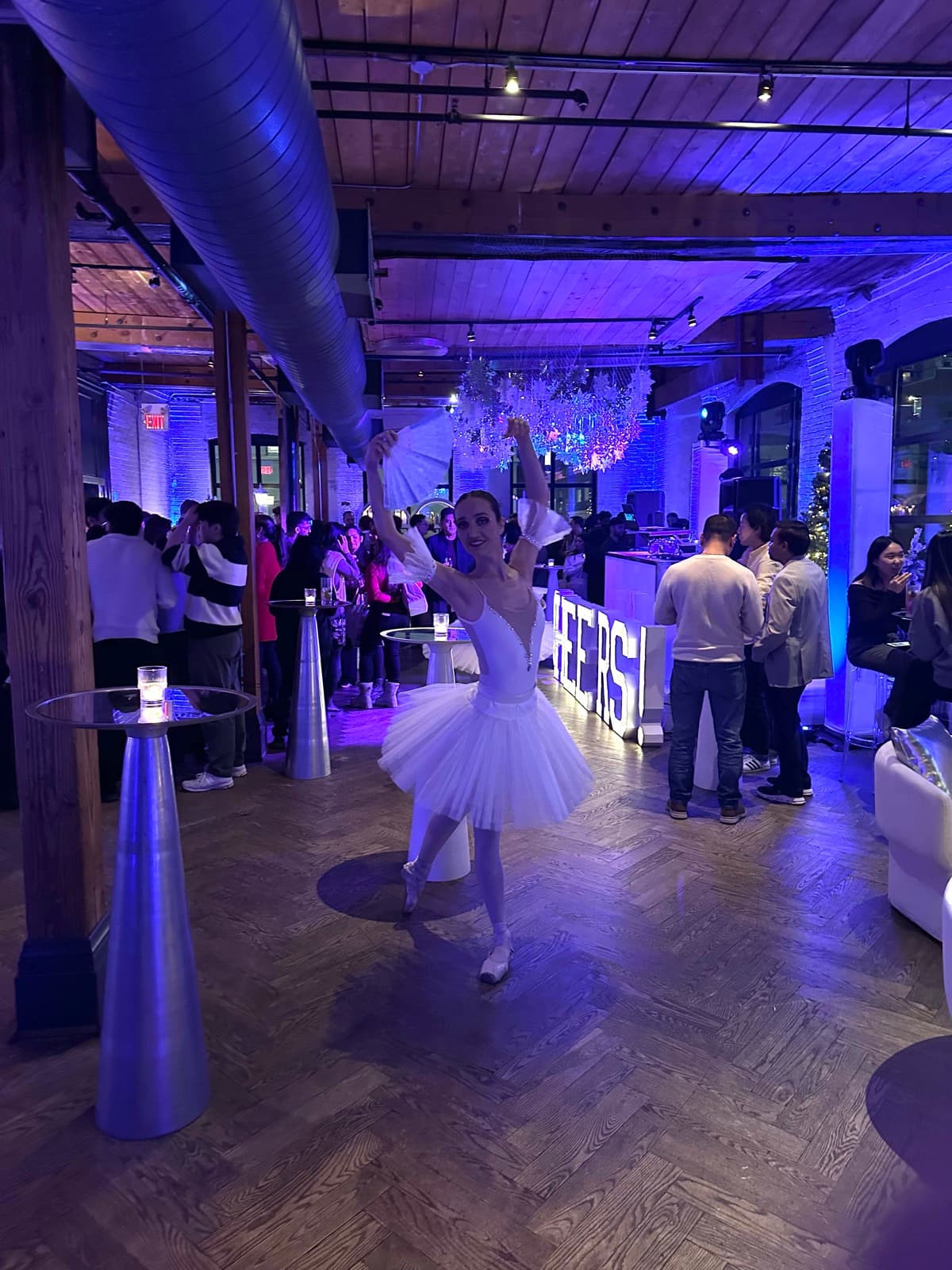
There is a practical argument for a character venue at the holidays, and it is not really about photographs. A room with its own architecture does a share of the work that would otherwise land on your decor budget. Storys was completed in 1925 and the brick-and-beam interior is the room, so the money that would go on dressing a neutral ballroom can go into food, drink and the parts of the evening people actually remember.
The two-floor layout also solves a specific holiday-party problem. Arrival drinks and dinner do not have to share a room, so there is no gap in the evening while staff reset around your guests.
Booking at Storys
We are at 11 Duncan Street in the Entertainment District, which is walkable from most downtown offices and straightforward for anyone coming in by transit or rideshare. Food and beverage is handled in house.
December 2026 dates are going now. Talk to our events team about what is still open, or read more about corporate events at Storys.